Showing posts with label Buzzard. Show all posts

Wednesday, 27 September 2017

19th August Trip to Dinnet and the back of Glen Tannar

One of a few not very succssful trips was a day at Dinnet with Alex.  The aim was to find a Redstart for my list and a Green Woodpecker for Alex to move from his 'heard' listing to a 'seen' listing and of course to get photographs.

We Started at the Vat o' Burn carpark and crossed the road into the Muir of Dinnet NNR.  This is where Alex had seen Redstart last year.  Of course this year the most exotic bird was a Robin.

Robin
We went to parts of the birch woodland that I did not know existed.  There is a long boardwalk over marshy ground that held lots of Dragonflys

Black Darter

The other insect that was abundant was a Scotch Argus butterfly.  I had never seen one before and for some reason I thought they lived on heather moorland and were rather scarce.  Actually they live in damp woodland and are common at least locally.  This one was on heather so I was partialy right!

Scotch Argus
 From Dinnet we went just a little way to the South Deeside Road to walk a farm track that basiclly led round the back of the Glen Tannar estate.  Here the target was Green Woodpecker, Tawny Owl and Garden Warbler. What we saw was Crossbill and Buzzard.  Now, you know and I know that Crossbills live in conifers and eat the seeds out of the cones.  So it came as something of a surprise to see two of them flying from one willow tree to another.


Crossbill

Crossbill
We also know that there are three types of Crossbill that live in Scotland, Common, Scottish and Parrot.  It takes something of an expert to tell the three apart.  What you need, to be certain is a DNA testing kit and sound recording equipment that will produce a sonogram, a sort of chart showing the sound frequencies of the birds call.  Alex and I only had our cameras but we are told that these are Common Crossbills.  Our hunt for Scottish and Parrot Crossbills has to continue.

And we saw a Buzzard....
Buzzard


Buzzard


.... and took some other photos as well

A large derilict looking barn with new bails

Very Old Potato Harvester

Old Gate New Fence
  I've put these up because somehow they typify the Scottish Highlands countryside.  These were all in the same place and I could have taken more of the same, the lorry that clearly no longer fit for the road, the pile of large bits of wood, the rusty old stock feeding thing.  You get the idea.  When I first moved up here I was all for something being done to tidy up the countryside and get rid of all the debris and scrap that is lying around.  That was fifteen years or so ago.  Now my attitude has changed.  I don't want the old barn and steadings converted and 'gentryfied', I want to see old farm machinery, yes and rusty old cars, and I want to see old wooden gates.  Along with the mountains and the moorland, the (highland) cattle running with calves and herds of sheep these things from the past, often no longer useful are what makes Scotland, well Scotland and unique.  And they are good for wildlife.  See the lichens on the gate.  How many mice and voles live in the field with the uncut grass and the potoato harvester that feed owls, kestrels stoats and weasels.  What nesting habitat is there in the derilict looking steading and for what cretures?  Many rural parts of England and alas of Scotland to are becoming too tidy, too efficient at the expense of our wildlife.  And that is not good for the soul or the mental health of the nation.

Rant over

Total on list 201

August Morning Walks

My morning walks continued as usual, almost, on one day I was joined by Neve my granddaughter who wanted to get up early and come on the walk with me when the family visited.

Neve Striding Out

 On that walk we saw a Roe Deer and Rabbits and Lapwing

Roe Deer

Rabbit

Lapwing 


 Other walks produced a variety of birds and mammals but generally were quite
Fox

Roe Deer

Buzzard

Wren

Brown Hare
Total on list 201

Tuesday, 4 July 2017

Dee Valley. Balleter to Cambus of May and Dinnet

Sunday was an RSPB members nature ramble.  Organised by the NE Scotland Members group, we started at 10.00am on the South Deeside Road at Ballater.  The walk was led by Rob Leslie.  Ten of us set off and I'm sure to the relief of Rob ten of us finished the walk with Lunch at the Cambus o' May footbridge.


Eight of the Ten
 
It was raining when we got out of the cars.  Someone said that if it is raining at 10 0' clock it will rain for the rest of the day.  Fortunately this weather forecasting tale was not 100% fool proof.  The rain soon stopped and did not return.

At the first stop just a few hundred yards along the road we got a good view of the river and were able to see a few of the specialist riverine birds.

Grey Wagtail

Common Sandpiper
There was also Swifts, Sand Martins, Swallows , House Martins and a Dipper.

As we carried on a Buzzard flew overhead taking some newly found road kill home.

Buzzard

Not long after we left the road and followed the path through woodland and by some paddocks.  Here we found Willow Warbler, Coal Tit, Blackcap, Treecreeper, Tree Pipit, Goldcrest and other woodland species.  Many of the birds were newly fledged young.  Others seemed to be tending nests nearby.  The breeding season was in full swing.

Young Tree Pipit
For most of the walk there was one  moth/butterfly that was abundant but only identified after we all got back home.  It as a Chimney Sweeper Moth.  It was only a couple of centimetres across but its dark colouring and constant fluttering flight made it stand out against the green of the grasses and bracken.

Chimney Sweeper Moth
The other non-bird nature thing that was abundant was the Wood Ant nests.


Wood Ant Nest
They came in all sizes from smaller than a mole hill to the one above that was over two feet high.  Each one was a hive of activity (if that is an expression you can use for ants). Even so the big ones must have taken years to construct. 

A video taken on my mobile phone
We ended the walk at the Cambus o' May suspension bridge.  A peaceful spot for lunch apart from the family on the other side having a great time in the water.  It must have been very cold!

Alex and Trevor at the Cambus o' May Bridge
The official RSPB members walk finished here but I went with Alex and Trevor to the oak woods at Dinnet.  The aim was to find a Redstart and a Green Woodpecker.  We didn't see either of them although we reckon we heard young woodpeckers.  This little excursion became an insect hunt.  Of course there were the inevitable Chimney Sweeper Moths but we also found butterflies -  Speckled Wood, Small Pearl Bordered Fritillaries and Red Admirals and a Four Spotted Chaser dragonfly

Speckled Wood
Small Pearl Bordered Fritillary
This is my photo of the butterfly.  For some reason I managed to pick what was probably the most tattered one around.  The next photo was taken by Alex and is so much better than mine in so many ways.

Small Pearl Bordered Fritillary by Alex Jamison
Four Spotted Chaser
Total on list 192

Monday, 22 May 2017

Onehundredandeighty!!

Sunday 14th May started out well.

I came home from my morning walk with a tick for the year list.  It was just a 'heard' tick.  I did not see the Blackcap that was singing away.

Once I had got home I got the call that there was a Pied Flycatcher at Rattray.  Rattray is not far away so off I went.  No Pied Flycatcher in fact nothing of note to see unless you count the others who were looking for it as well.

Back home again and another call out.  This time it was a Wood Sandpiper at the Loch of Strathbeg.  Strathbeg is even closer to home than  Rattray so I had to go.  This time I was lucky.  The Wood Sandpiper was still there and I also saw a Ruff - one tick for the year list.

In the absence of any photos of the days ticks here are some others I took

Willow Warbler

Buzzard

Rabbit with nesting material

Female Bullfinch

Common Tern

Mute Swan and Cygnets


On 17th May I went to the Ythan Estuary to try out my new telescope and tripod.  Alex picked me up in the morning and as we both had to be back by lunchtime the time there was limited.  Alex's ulterior motive in doing the driving was three fold.  He wanted to see what the 'scope was like before he took the plunge to upgrade his equipment and he wanted to see if he could find a Roseate Tern among the Common. Arctic and Sandwich in the colony.  He also wanted to give he car a run as it was overheating.

It was a windy day and not very warm and soon our eyes were watering making it extremely difficult to see clearly.  The birds were not cooperating either.  They were mostly resting the sand with their heads tucked under there wing.  One of the main ways of telling Common, Arctic and Roseate terns apart is by bill colour and that was not possible.  The other trick that the terns played on us was to rise up into the air en mass, fly around and land again taking up their original posture of hiding their bill.  But they didn't land in the same place so you had to start again looking through the birds trying to find the Roseate.  It was a bit like a pack of cards being shuffled before you had a chance to see them all.  I haven't got a photo of the terns but i do have one of the seals that haul out at the mouth of the estuary.  The tern colony has been out of bound to the public for a long time the seal haul out area has only recently (this year) been designated as such and therefore officially out of bounds.  There has been a growing problem of people, some with dogs, trying to get close to the seals to take photos.  So close in fact that they have put themselves at risk and the disturbing the seals.  To find out more about the Ythan seals go to the Ythan Seal Watch Facebook page.

Seals at the Ythan Estuary

Anyway the good news about the trip was that I saw Little and Arctic Terns for the first time this year.

Total on list 180

Tuesday, 11 April 2017

The Egg Thief

11th April

This morning I spend two hours getting the paper.  Well ten minuets getting the paper (there was a queue at the shop in Crimond) and an hour and fifty minutes at the Loch of Strathbeg.  There was not a great deal to see from Fen Hide.  Opposite the hide on the far side of the Loch there was an RSPB working party doing something with large lengths of timber.  Not surprisingly most of the birds had found somewhere else to be.

On the way back to the hide I witnessed the cruel side of nature.  My attention was drawn to two Magpies and a Carrion Crow having a bit f a noisy argument.  In a nearby tree a Buzzard was stood on its nest
Buzzard
The Magpie/Crow argument moved into the Buzzards tree.
L to R Buzzard, Two Magpies and a Crow
 For some reason the Buzzard left the nest.  The Crow doubled back and swooped on the nest.  Its prize, an egg.


With all that excitement over I got back to the car and drove to the Visitors Centre.  On the way passing through Crimond Airfield I saw a Wheatear, a nice tick for the year list.  I was driving so was only able to get a very, very blurry photo.  Other photo opportunities will arise during the summer.  Back at the Visitors Centre another tick was waiting in the form of two handsome Black-tailed Godwits seen though one of the Centres telescope.   There was plenty of other birds about as well.  In less than two hours I had 45 species including two new ones for the year.

Total on list 144

Sunday, 12 March 2017

Where Eagles Dared

11th March 2017

Now this was a big trip.  Brian asked if I wanted to go to the upper Findhorn Valley, otherwise known as 'Raptor Alley'.  The goal was to find a Golden Eagle.  Quick check with Jill that there were no other plans and we were good to go.  We started at 7.00am and I got back home at 6.30pm. In addition to Strathdearn we called in at Spey Bridge just outside Grantown on Spey to find a Hawfinch.  This is where I had seen them on the 8th January and where we had both seen them last year. Brian wanted Hawfinch for his year list.  It had been reported that one had been seen three days before.  Finding one Hawfinch along the banks of the Spey was always going to be a difficult task.  There were Chaffinches, Greenfinches, a Song Thrush, Mistle Thrushes, Blue and Great Tits, Long-tailed Tits and Goldcrests but no Hawfinch.  On the water we saw a pair of Grey Wagtails, a Dipper and a pair of Mallards.  The other notable sighting was a Weasel in the road just as we got to Spey Bridge.
Long-tailed Tit

Female Mallard

Dipper

It is another hours drive to the Upper Findhorn Valley.  the last ten miles is on a single track road with passing places. The local council seemed to have skimped on the size of the passing places.
At one point we had to back up to let a car past.  Now Brian knew what he was doing and I knew that Brian knew what he was doing but that still doesn't help the nerves when you are looking out of the passenger window and the edge of the road is mighty close and there is a 30 foot or more drop into the valley below and the 'your are getting too close' beeper is going like mad because to get the two cars past each other wing mirrors had to be folded in.

But we got there all in one piece.  As soon as we got out of the car Brian shouted 'There's a Mountain Hare' pointing up a seemingly barren mountain side.  He was right, there was a mountain Hare.

Mountain Hare taken with a 400mm lens from the car park
We decided to try to get closer.  The Hare sat in its little niche in the hillside until we got quite close.
Mountain Hare Looking Cross
 It did eventually think we might be hostile and it left its spot and run up the hill.

When we got down to the valley floor and looked back we saw that the Hare had returned to the same spot.

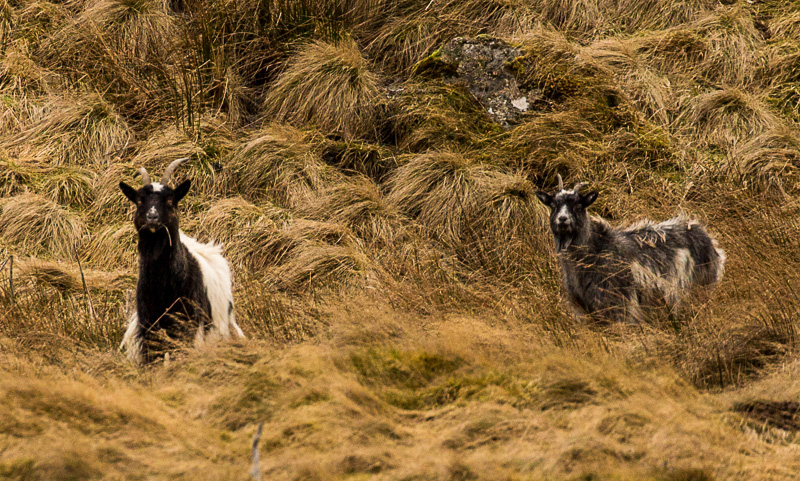
This is when the walking started. It is a one and a quarter mile  slog along the track to get into Eagle territory.  The only things of interest we saw were two Ravens and some Feral Goats  This would make mammal number five if you count the road kill badger and squashed rat.
Feral Goats
From the car park we were accompanied by a little black terrier
Our Walking Companion
Just over a bridge we had a choice, carry straight on along the valley bottom, on a previous visit Brian had seen a pair of Golden Eagles that way, or turn right following the river Calder,  others had seen Eagles this way.  We turned right.  This path took us on a 250ft climb which eventually came to a ford that, given the amount of water in the river, we deemed impassable.
The Ford
 We still hadn't seen anything and headed back the way we came.
Brian Scanning the Skyline for Eagles


Did I mention that the scenery was stunning?  It was stunning.


On our return to the valley we were extremely surprised to see a bat in the broad daylight (Mammal No 6).  By this time our doggy escort had deserted us.

As we had yet to find an Eagle we thought that it would be foolish not to explore the path that continued up the valley.  About a mile along here we saw it, a Golden Eagle.  I have to admit that we were a little confused.  The bird came into sight from behind us and soared above the mountain to our right, it then disappeared from sight.  A moment later what we thought was the bird reappeared but this time it was clear that it was only a Buzzard.  We had to examine the photos we took of the first bird to reassure ourselves that we had indeed seen a Golden Eagle.
Golden Eagle
Common Buzzard
All that was left to do was to walk the couple of miles back to he car. Some more Goats and a Dipper and a herd of Red Deer (Mammal No 7) later we got back to the car park.

Dipper
You are Kidding
Red Deer

In all we had been out away for about five hours so you won't be surprised to know that the Mountain Hare was still in its mountain side niche.

Still Hare
Now all Brian had to do was drive home starting with ten miles of single track road. Mammal No 8 was a Brown Hare seen from the single track road  He did it in less than three hours we were back in Fraserburgh at 6.10pm

Total on list 127