I was up well before the lark yesterday. The alarm was set for 3.00 am. The plan was to pick up Alex at 4.00 and be at Glen Muick for 6.00 in the morning. The mission was to see a Black Grouse lek.
And that is what happened. However the wildlife watching happened before we parked the car. On the way up the glen there were tens perhaps over a hundred Red Deer just at the road side. The photos are rather grainy because the light was poor and the ISO cranked up to get a good exposure.
 |
| Red Deer |
Mostly the deer were standing around in loose groups and not posing as one would have liked. There were exceptions
 |
| Three Red Deer |
|
One or twice we got one of the stags to strike a classic 'Monarch of the Glen' pose.
 |
| Red Deer Stag |
Interestingly all the stage seemed to be sporting their 2016 antlers although it is this time of year that they are discarding then to grow the 2017 updates.
The other encounter on this road was with a Mountain Hare. It stopped just by the road but was off before Alex could get a photo out of the passenger window. We were not to know that this would not be our only Mountain Hare encounter so were cursing our missed photo and consoling ourselves that it was in any case too dark to get a decent image.
Both Alex and embarked on this adventure for the day in the hope that we would see some birds to tick on our year list. Alex has the same ambition as me - to get to 200 birds by 31st December 2017. Like me this is the first, and possibly the only time we will do such a thing.
Neither of us expected that our first tick of the day would be a Red-legged Partridge. But just as we had seen to grouse in the bottom of the Glen we saw two RLPs close by. (Not to be confused with LRP birders abbreviation for a Little Ringed Plover or indeed LRPs which in the days of vinyl records that are making a comeback is a Long Playing Record)
Mostly they spent their time with us scurrying round in the tussocky grass trying not to be seen.
 |
| Red-legged Partridge |
But they clearly decided that the only way to stop us looking at them was for one to come out into the open and give us a good photo opportunity before they disappeared.
 |
| Red-legged Partridge |
 |
| Red-legged Partridge |
I have always thought of the RLP as a bird of lowland farmland. On the drive to Glen Muick Alex and I wondered where we could find one for our 2017 list and came to the conclusion that it would have to be one of those birds that was seen as a matter of luck rather than careful planning. So our luck was in and in a most unexpected place.
So on to our main goal for the day. This was to be a tick for Alex but not for me. I had seen a Black Grouse on 29th January (see the blog post 'Sundays Big Trip'). This would be my first male Black Grouse of the year and the first time I had visited the lek for some time.
First I have to make it clear that this is a well known lek and is in a wardened area, second that we kept our distance in order not to disturb the birds. The following photo was taken with a 400mm lens and as you can see they are a long way off. A Lek by the way is an area where male birds meet to display and on occasions fight to determine which one has the right to mate with the females. It is however the female bird that makes the final choice. Several bird species do the mating thing in this way. Black Grouse Lek for muck of the year but April/May is the key time of the year.
 |
| Black Grouse at the Lek |
Here are some heavily cropped photos, so the quality is not that good.
 |
| Black Grouse Squaring Up |
Sometime more than two birds are involved
 |
| Black Grouse Displaying |
Red Deer also seemed to have got the bug and a couple were playing at the rut in a halfhearted fashion. As you probably know the rut in earnest is an Autumn spectacle.
 |
| Red Deer |
Yesterday morning at one time we counted 17 birds on the Lek. All the black grouse we saw were males.
By 8.30 the lek was over. The birds were drifting away from the display area leaving the glen floor to the Lapwing, Oystercatchers, Curlew,
Greylag Geese and Common Gulls. The Red Deer having already left.
 |
| Lapwing |
 |
| Common Gull |
 |
| Greylag Geese |
Red Grouse were all around us, mainly up on the mountain sides.
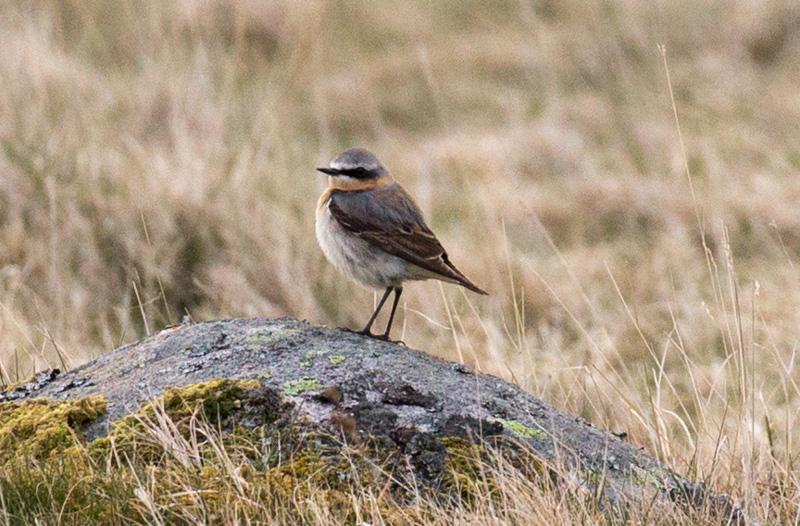
On the way back to the car we got a bonus of a Wheatear, another tick for Alex.
 |
| Wheatear |
A better photo of a Wheatear than the one I didn't dare put on my blog post of 11th April 'The Egg Thief' but it could be better still.
From Glen Muick we decided to go in search of another two year list ticks at Glenshee. Glenshee is a ski resort some 2,000 ft above sea level. We hoped to see snow buntings and Ptarmigan.
The Ptarmigan, pure white in the winter would have shown up well as there was no deep snow. In the spring they start to moult into their brown and grey summer plumage. This made then the same colour as the rock strewn mountains with a pockets of thin snow. We did not see a Ptarmigan despite and extensive search with telescope and binoculars. The only snow bunting we saw, was like the Ptarmigan donning more brown and grey than its white winter winter feathers on a distant fence post but nevertheless a year tick for me.
The other creature changing from winter white to summer grey and brown was the Mountain Hare. There were so many of them that only the most casual of glances would miss them. They were constantly on the move which instantly gave them away. We could have watched them all day but had to remind ourselves that we were looking for Ptarmigan. But that didn't stop us from going a long way to filling the cameras' memory card with cute pictures.
We eventually gave up trying to find the Ptarmigan and headed back down towards Braemar and back down the A93 to Aboyne to cross the river Dee and have lunch at Glen Tanar. We than went on a four or five mile walk on the three bridges route and saw very little, on Crossbills, no Capercallies, but lots of Chaffinches.The only bird of note was a Bullfinch.....
 |
| Bullfinch |
....until we got back to the car at the stables car park. Last time we were at Glen Tanar see blog post for 28th March 'The Beast') Trevor told us that the fields by the stables were good for Green Woodpeckers. We spent some time scanning the fields and came up with Blackbirds, Starlings, Song and Mistle Thrushes and Pied Wagtail. We then heard the unmistakable yaffle of a Green Woodpecker coming from over the wall behind us. Thank you Trevor, at the time I was a bit sceptical but you were right. It is a good spot for Green Woodpecker. Unfortunately it remained behind the wall and went unseen. Of course it means we will have to go back at some time.
Lets leave this blog not with wild life but with some scenery
 |
| Loch Muick |
 |
| Little Waterfall, Glen Muick |
 |
| Little Waterfall, Glen Tanar |
Total on List 146